
Friday, November 7, 2008
I'm Back

Friday, October 24, 2008
Fear and Loathing on the PhD Trail.
 Tomorrow morning, I leave Caracas and return to Chicago to sit a French exam and defend my dissertation research proposal in front of a committee of professors. These are the last two hoops I have to jump though before I get PhD candidate status, and frankly, I'm bricking it. Practicing French while living in Venezuela has been interesting, as has writing a research proposal without access to any books. Keep your fingers crossed for me, and I'll be back in a week.
Wednesday, September 24, 2008
Artifacts
 Yojimbo's Track Cats supporters shirt - Available from Yojimbo's Garage, 100% of the purchase price goes to support the Track Cats program.

 Cycle Sport America (thanks, Andrew!) and ProCycling, two of the best cycling magazines available.
Similarly, Daniel Miller, in his introduction to the book Acknowledging Consumption, suggests that instead of attempting a general catch-all definition we should understand consumption as a 'dialectic between the specificity of regions, groups and particular commodity forms on the one hand, and the generality of the global shifts in the political economy and contradictions of culture on the other,' (Miller 1995 : 34). Thus, attention must be paid to both the native categorizations specific to local practices of consumption, and the larger global context, while all the time aware of the academic need to 'generalize as a means of analysis,' (Miller 1995 : 31).
Both Miller and Appadurai would also agree that one of the generally important aspects of consumption is its construction, negotiation and expression of meaning. Jean Baudrillard highlights the communicative aspects of consumer goods in his book The Consumer Society, when he says that consumption is no longer defined as 'a fundamental practice of objects or as a mere individual group or prestige function but as a system of communication,' (Baudrillard 1998 : 93). Similarly, Appadurai suggests that consumption is the 'focus not just for sending social messages but for receiving them as well,' (Appadurai 1986 : 31). Miller notes that 'consumer goods commonly serve to communicate social distinctions or reinforce relationships of superiority and inferiority between individuals or groups. They may also be instrumental in creating or confirming an individual’s sense of self or personal identity -- people have found that an identity constructed through consumption is far more empowering and controllable than that which is dependent upon their placement within ever larger systems of production over which they have little control,' (Miller 1995 : 42). This is one reason why Miller says that consumption, as one of the prime processes in the formation of cultural identity, should become a central object of study for anthropology.


 CSC cap. The best team in cycling. Seeing as the team is changing to Saxo Bank next year, I bought a lifetime's supply (well, 5) of these caps.
Of course, all of this is not to deny Marxist critiques of the commodity form. But, applying a material culture semantic analysis to the popular culture of cycling might also be productive, as it is a culture in which consumption of goods, far from being an “erosion of culture” (Miller 1995 : 268), is elemental in the construction of culture.


Works cited:
Appadurai, A., 1986 The Social Life of Things. Cambridge: Cambridge University Press.
Bauldrillard, J., 1998 The Consumer Society. London: Sage Publications.
Miller, D., 1995 Acknowledging Consumption. London: Routledge.
Tuesday, August 26, 2008
Slavoj Zizek
"For the past two years, a mysterious disease has been wiping out honeybees in the US and Europe. This catastrophe could have a devastating effect on our food supply: about a third of the human diet comes from insect-pollinated plants, and the honeybee is responsible for 80% of that pollination. This is how one should imagine a possible global catastrophe: no big bang, just a small-level interruption with devastating global consequences.
There is an air of mystery to this mass death. Although the same thing is happening all over the developed world, local investigations point to different causes, such as the poisonous effects of pesticides, or the loss of the bees' sense of spatial orientation caused by the electronic waves of our communication machines. The multiplicity of causes makes their links with any effects uncertain, which invites the temptation to look for a deeper meaning and consider the so-called "spiritual ecology": is a beehive not a kind of slave colony, a concentration camp where bees are ruthlessly exploited? What if Mother Earth is punishing us?
The best antidote to this spiritualist temptation is to bear in mind the lesson of Donald Rumsfeld's theory of knowledge - as expounded in March 2003, when the then US defence secretary engaged in a little bit of amateur philosophising: "There are known knowns. These are things we know that we know. There are known unknowns. That is to say, there are things that we know we don't know. But there are also unknown unknowns. There are things we don't know we don't know." What Rumsfeld forgot to add was the crucial fourth term: the "unknown knowns" - things we don't know that we know, all the unconscious beliefs and prejudices that determine how we perceive reality and intervene in it.
In the case of the disappearing bees, there are things we know that we know (their vulnerability to pesticides) and things we know that we don't know (say, how the bees react to human-caused radiations). But there are, above all, the unknown unknowns and the unknown knowns. There are dimensions of how bees interact with their environs which are not only unknown to us, but which we are not even aware of. And there are many "unknown knowns" in our perception of bees: all the anthropocentric prejudices that spontaneously colour and bias our study of them.
The most unsettling aspect of such phenomena is the disturbance in yet another type of knowledge, in what the French psychoanalyst Jacques Lacan called "knowledge in the real": the "instinctual" knowledge that regulates animal and plant activity. This can run amok. When winter is too warm, plants and animals misread the hot weather in February as the signal that spring has began and start to behave accordingly, thus not only rendering themselves vulnerable to late onslaughts of cold, but also perturbing the rhythm of natural reproduction. Something of this kind is probably happening to bees.
We pride ourselves for living in a society in which we freely decide about things that matter. However, we are constantly in the position of having to decide about matters that will fundamentally affect our lives, but without a proper foundation in knowledge. This is frustrating: although we know that it all depends on us, we cannot predict the consequences of our acts. We are not impotent but - quite the contrary - omnipotent, without being able to determine the scope of our powers. While we cannot gain full mastery over our biosphere, it is in our power to derail it, to disturb its balance so that it will run amok, swiping us away in the process."
Originally in The Guardian. You didn't think I had Slavoj feckin' Žižek on staff, did you?
Monday, April 7, 2008
Marxism and Cycling
 Tonight, I got into an online argument about Marxism. Why? Because I'm an anthropology graduate student. It's what we do.
Anyway, I'm now thinking of picking up this hat, except that I haven't doped enough to be anything like a Soviet cyclist. Better get the oul' Albuterol out!
Tuesday, January 22, 2008
Hello, I am in Venezuela.
Amy and I are in Caracas, Venezuela! We're here so that Amy can do her dissertation research on the Venezuelan public healthcare system. I'm just along for the ride, basically. We had a mental week, which consisted of packing to move here for a year, moving everything else out of our apartment and into a storage space, and saying goodbye to some of the greatest people ever. Our going away party was a blast. $15 all-you-can-drink and a loose Aerospoke makes for a good night out.

I'm going to miss everyone a lot. They're a bunch of degenerates and elitist misanthropes in the main, but they're good craic, and a few of them even know how to ride bikes. They got me a Campagnolo peanut butter wrench as a going away present. They even got my name engraved on it.
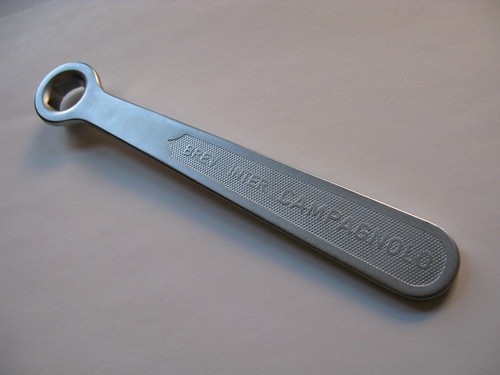

Classic!
Well, that's it for now. We only arrived a few hours ago, but the place we're staying at has WiFi so I thought I'd do a quick update before I crash. Coming soon: photos of me trying to re-assemble our road bikes; a report on how much my shitty wheels flex on Caracas hill climbs; more race reports from last summer's track season which are kind of made up because I can't really remember that long ago; and any random rubbish I feel like writing.
Monday, December 31, 2007
My Anthropology Year in Review.
 Self, Culture and Society is, essentially, an introduction to the ways in which the social sciences have engaged with ideas of, you guessed it, the self, culture, and society. So, we read people like Adam Smith, Marx, Durkheim, Freud, and Foucault. Each quarter I interned with a different professor, and I basically sat there and listened while they taught, occasionally interjecting usually unwelcome comments and looking a little like a strange, older undergraduate. I was supposed to teach one class each quarter, but in the Winter quarter I had to teach several classes when the professor became unavailable suddenly. This meant that I had to teach, on very short notice, Theodore Adorno’s essay The Fetish Character of Music and the Regression in Listening. I’m not sure the kids got much from that particular class. I actually received a horrifically bad evaluation from one student, but I reckon one bad review out of sixty or so isn’t too bad. Anyway, I really enjoyed teaching, which is good because I hear it’s a big part of being a professor…
In April we learned that both Amy and I had won Fulbright-Hayes Doctoral Dissertation Research Abroad grants. This means that we each get the money necessary to go away and do our research. It was a phenomenal feeling to realize that the work we’d been training to do for so long was actually going to happen. It’s hard to express this aspect of graduate school to people. That you’d get into a Ph.D. program, take classes for years, and then not be able to do your dissertation work and thus graduate seems pretty strange, but it’s a very real possibility. I know intelligent and hardworking graduate students with interesting research topics who, for whatever reason, have been unable to secure funding. They have to reapply with new and improved proposals, which takes a year, and there’s no guarantee that the new proposal will be funded either. I know of a few grad students who couldn’t get funding and had to leave their programmes. I mean, I know that no time spent learning is wasted, but feckin’ hell, I’d go mental if all the work I’d done for four years, not to mention the money I’d spent, had been for naught. Nightmare!
In the Summer I won, miraculously, a Provost’s Summer Fellowship, which allowed me to pay rent. In the Autumn I prepared for and took my qualify exams, which I’ve written about already. I also managed to take care of a couple of long-standing incompletes that had been with me for a while, and began an intensive French class to help me pass my language exam, which will be in February.
In sum, it was a very successful year. I got some teaching experience, which is hard to come by here. I secured funding for my dissertation research, as did Amy, which is a huge weight off our shoulders. Finally, I passed my exams, and with only minor psychological damage. I think I finally realized the extent to which graduate school is all about competition and ambition. But hey, I’m not complaining. Even though it can be stressful and hard, it can also be, as in the case of teaching those classes, incredibly rewarding. I feel very, very lucky to be doing what I’m doing. As the man said, sure it’s indoor work with no heavy lifting.
Sunday, December 16, 2007
Qualifying Exams.
 I'm not the first person ever to do exams, but you'd swear I was given how much I've been complaining about them. Essentially, the problem is that I'm afraid of hard work.
Four weeks to read over 80 items, including 36 full books, followed by 5 days in which to write 2 essays on questions emailed to me by my committee members. Then, an oral exam in front of my committee. I made it as hard on myself as possible by having been a lazy swine for the last couple of years. Everything on the list I should probably have already read, but hadn't. The reading list was split into three sections: Nation, Nationalism and the Politics of the State; Colonialism, Postcoloniality and Race; The Military and Masculinity. I read most of the list... but not all of it. The questions I got from my committee came out of left field, to whit: "What distinctive contribution, in your critical view, has anthropology made to the theorization of (i)modernist nationhood, (ii) the politics of the modernist state, and (iii) the hyphenation of the modernist nation-state?"
Er.... what??
I don't know how, but I got the two essays done, turned in on time, and then went in early on Monday morning for the oral. It started well: I killed a silverfish on the wall and asked if killing the beast was the test, and had I passed? Laughs all round, but no, that wasn't the test... One of my committee told us a story about how, during a job talk, a rabid squirrel had emerged from a fireplace and had attacked the faculty members interviewing her. Another committee member told us of how, in the middle of a lecture to 150 students, the departmental secretary had burst into the hall to tell him that his wife had called to demand he return home and rescue her from the squirrel that had invaded their kitchen. More laughs. But, eventually, we got down to brass tacks, and I waffled on for a couple of hours about the state, the military, Fiji, war memorials, race, the nation, the liberal subject, and something I fancifully called "generalized death."
After a while they got sick of me, and asked me wait outside. When they emerged, they told me I'd passed, and that I should immediately get started on the next phase, the departmental proposal. Oh, brilliant yeah, cheers, I'll get right on that! Amy was waiting outside, so we left to celebrate.
Saturday, December 15, 2007
Introduction.
This is my first attempt at a blog, I've no idea what to write, and frankly I have no idea why anyone would want to read it, but here it is nonetheless. Soon, I'll be leaving Chicago to move to Caracas, Venezuela for a year, while my wife conducts her fieldwork. The blog will give me both something to do, because I don't yet speak Spanish, and an easy way to record the experience of moving to a different country. In the meantime, I'm going to post up a couple of race reports that I wrote but never got around to adding to my team's blog, and the usual bullshit like photos, videos, and wildly misguided opinion.
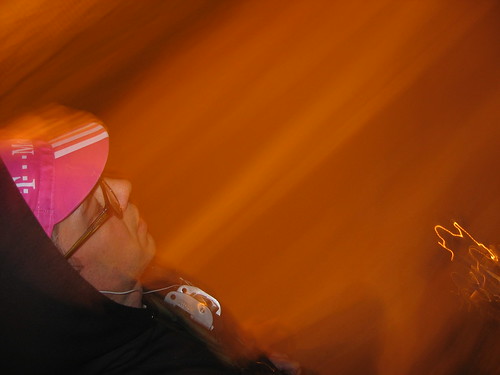
Since I doubt that anyone who doesn't know me will be reading this, I should probably dispense with the formalities in short order. I grew up in Raheny on the northside of Dublin, Ireland. I'm 32. I'm married to Amy, who is the best. Obviously. I'm studying for a Ph.D in anthropology at the University of Chicago. How I got into the U of C remains a mystery, and apparently a source of some consternation to my department. Feck them! My dissertation is about the recruitment of Fijians into the British Army. After Caracas, Amy and I go to Fiji for a year so that I can conduct my fieldwork. It's a tough life!
I ride for Team Pegasus, the preeminent hipster cycling team in the Midwest. We're the shit. For real. We compete on the track, the road, in cyclocross and in mountain biking. We go out there to have a good time, first and foremost, but we also like to win and even though we've only been around a year we have a growing reputation. Check out the team blog here. I ride track, and just finished my first season. I did pretty well, competing at Northbook, Kenosha and Hellyer velodromes, progressing from Cat5 to Cat4, and managing to finish in the top three at least once every race night, except for my last night of racing, which sucked.
That's all you need to know. Next, I'll post up a couple of race reports from the summer. Don't worry if this is all a boring load of oul' shite now, I'm sure it'll get funny and interesting once I'm strolling around Caracas like a lunatic, desperately trying to blend in even though I'll be the only person slathered with factor 45 sunblock...